

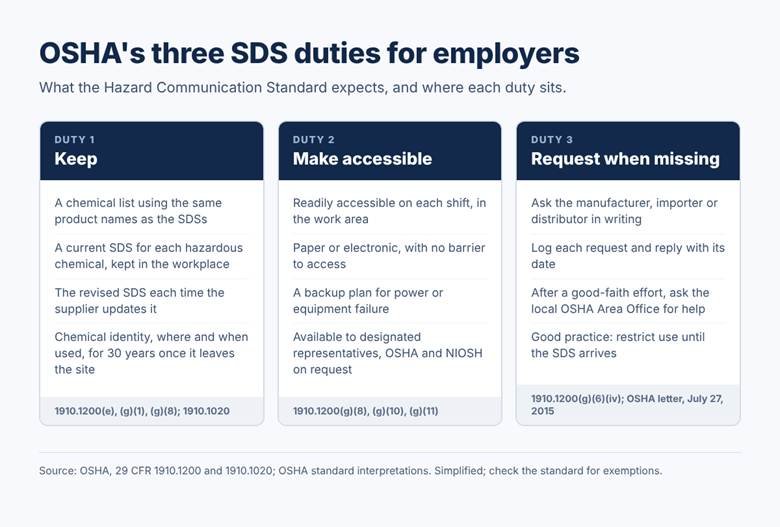
Employers covered by OSHA’s Hazard Communication Standard have three safety data sheet (SDS) duties: hold a current SDS for every hazardous chemical on site, make each one accessible during every shift, and document their requests to the supplier when an SDS cannot be found. Hazard Communication was the second most-cited OSHA standard in fiscal year 2025, with 3,010 violations on the final count.
A contractor has refilled a parts washer with a solvent bought from a local supplier. Nobody adds it to the chemical list, and no SDS comes with it. The gap stays invisible until someone is splashed, or until an inspector picks that drum and asks to see its safety data sheet.
Each of those duties sits in a few paragraphs of the standard, and most problems start in the gaps between them.
When is an SDS required, and when is it not?
An employer needs a safety data sheet for each hazardous chemical it uses, under paragraph (g)(1) of the Hazard Communication Standard, 29 CFR 1910.1200. What decides it is whether the chemical is classified as hazardous, not how much of it is on site or where it was bought.
Paragraph (b)(6) lists what the standard does not cover. The list includes hazardous waste regulated under the Solid Waste Disposal Act, tobacco, some wood products, articles, food and drink in retail settings, certain drugs, cosmetics packaged for retail sale, nuisance particulates, radiation and biological hazards. An article is a manufactured item, such as a length of pipe, whose use depends on its shape and which releases no more than trace amounts of a hazardous chemical in normal use.
Consumer products need the most care. The exemption in (b)(6)(ix) applies only where the employer can show the product is used for the purpose its manufacturer intended, with exposure no longer or more frequent than a consumer’s. A spray cleaner used once a week in a staff kitchen can pass that test. The same cleaner used by a cleaning crew for a full shift is unlikely to.
OSHA has said the employer carries the initial burden of proving consumer-type use, and that an employer who is unsure should obtain the SDS and make it available.
What OSHA SDS requirements say employers must keep
An employer keeps a matched set of records: a chemical list, a current SDS for every entry on it, and a few records around them. In detail, that covers:
- A chemical list that names each product by the same product identifier used on its safety data sheet, for the whole site or for each work area. Matching names is what lets anyone check the list against the SDSs.
- The SDSs themselves, kept in the workplace rather than at head office or with the buyer.
- SDSs that arrive with sealed containers, for operations such as warehouses that do not open them. Where a sealed container arrives without one, the employer has to obtain an SDS as soon as possible if a worker asks for it.
- The revised SDS each time a supplier updates it. Manufacturers and importers must send it with the first shipment after the update, and must add significant new hazard information within three months of learning of it.
- Old SDSs, or a record that replaces them, once a chemical leaves the site. Under 29 CFR 1910.1020, a safety data sheet counts as an employee exposure record. It need not be kept for any set period if the employer keeps a record of the chemical’s identity, where it was used and when, for at least 30 years. SDSs for chemicals still in use stay with the other SDSs in the workplace.
Matching the list to the SDSs is the quickest audit an employer can run. Gaps it can turn up include a product the supplier has renamed, a sample a contractor left behind, and an SDS still in the old MSDS format. The supplier has to provide an SDS on request. Current SDS sheets for many products can also be found by product name in a free online database of more than 30 million SDSs, with no account needed.
Where workers must be able to find each SDS
Paragraph (g)(8) requires the employer to make each required safety data sheet readily accessible during each shift, to employees in their work areas. OSHA interprets “readily accessible” to mean immediate access.
Paper binders and electronic systems both comply, provided the format creates no barrier to that access. An electronic system needs a plan for when it fails. In a 1999 letter, OSHA named power outages and equipment failure as the events to plan for. It accepted auxiliary power as a backup, and hazard information read out over the telephone, provided the SDS is delivered to the site as soon as possible. OSHA’s current enforcement directive asks to see back-up procedures for electronic access written into the hazard communication program.
The standard also allows some flexibility:
- SDSs may be kept in any form, including as operating procedures, and may cover a group of chemicals used in one process, provided each chemical’s information is there.
- Where workers travel between sites during a shift, the SDSs may stay at the main site, provided workers can get the information immediately in an emergency.
- On request, SDSs must be made available to workers’ designated representatives, OSHA and NIOSH.
A binder on a shelf still works for a small site. The practical test is whether a new hire on a night shift can find the SDS for the product in front of them without asking anyone.
What to do when an SDS is missing
The gap is a documentation problem first, because OSHA expects the employer to show a good-faith effort to obtain the document. A good-faith effort can follow these steps:
- Check the site’s existing SDSs and the supplier’s website for the current version before contacting the supplier.
- Ask the manufacturer, importer or distributor in writing. Under paragraph (g)(6)(iv), the manufacturer or importer must supply an SDS on request.
- Log each request and reply with its date. OSHA’s enforcement directive, CPL 02-02-079, expects the written program to set out the procedure to follow when an SDS does not arrive with the first shipment.
- If the supplier still does not respond, contact the local OSHA Area Office. In a 2015 interpretation letter, OSHA said the Area Office can be contacted for assistance once an employer has made a good-faith effort to get the SDS.
- Until the SDS arrives, treat the product as one whose hazards are unknown: restrict its use and mark the gap on the chemical list.
Where the manufacturer has gone out of business, OSHA’s position is that the employer should keep the most recent SDS it received rather than write a new one.
When the employer has to write the SDS itself
Some employers are also SDS authors under the standard. OSHA defines a chemical manufacturer as “an employer with a workplace where chemical(s) are produced for use or distribution.” Chemical manufacturers must obtain or develop an SDS for each hazardous chemical they produce. A site that makes a hazardous chemical, whether for its own use or to sell on, carries that duty for the product as well as the employer duties above.
An employer can also become the author by choice. OSHA has said an employer is under no obligation to create a new SDS for a defunct manufacturer’s product, but an employer that does so “will become the responsible party for its content.”
Writing an SDS means classifying the chemical’s hazards and completing all 16 sections in the order the standard sets out. SDS authoring software can automate the hazard classification, precautionary statements and section text from the CAS numbers entered and the regulation chosen. The employer that issues the SDS still owns its content, so a qualified person should review it before it goes out.
Five questions to answer before an OSHA inspector asks them
A serious violation can carry a penalty of up to $16,550, and a willful one up to $165,514, with no inflation increase for 2026. A site with evidence behind each answer is ready for the visit:
- Does every product on the chemical list have an SDS, under the same name?
- Can a worker or contractor find the SDS for a product in their work area now, without asking anyone?
- If the electronic system goes down, how does a worker get the information?
- For each missing SDS, is there a dated record of the requests made?
- Have workplace labels, the written program and training been updated for HazCom 2024? Employers had until November 20, 2026 to do so for substances, and have until May 19, 2028 for mixtures.
A practical starting point for SDS compliance
Pick one work area to start with. Print its part of the chemical list, walk the shelves, and match each container to an SDS that a worker in that area can open without help. Any container without an SDS that a worker can reach goes on the request log the same day, and into the chemical risk assessment for that task.
An SDS a worker can’t reach in the moment is, for compliance purposes, an SDS the site doesn’t have.