Ask anyone who has worked a shift on an ambulance or a patient transport vehicle where the risk sits, and most will point to the road or to the scene. Those risks are real. But a good share of the harm in this line of work happens in two quieter places: the moment a crew lifts a patient, and the building the crew goes back to between calls.
This piece looks at both. It uses official injury figures from Great Britain’s Health and Safety Executive (HSE) and the rules that govern water systems in workplaces, and it ends with a short list of things a station manager or safety lead can act on this month.
Why lifting is still the injury that won’t go away
Handling, lifting or carrying caused 17% of the non-fatal injuries to employees that employers reported to HSE under RIDDOR in 2024/25. Only slips, trips and falls on the same level (30%) caused more. Those shares come from 59,219 employer-reported injuries, and HSE says employers report only around half of what actually happens. The Labour Force Survey, which asks workers directly, puts the total at 680,000 workers injured at work in the same year (HSE, non-fatal injuries at work in Great Britain).
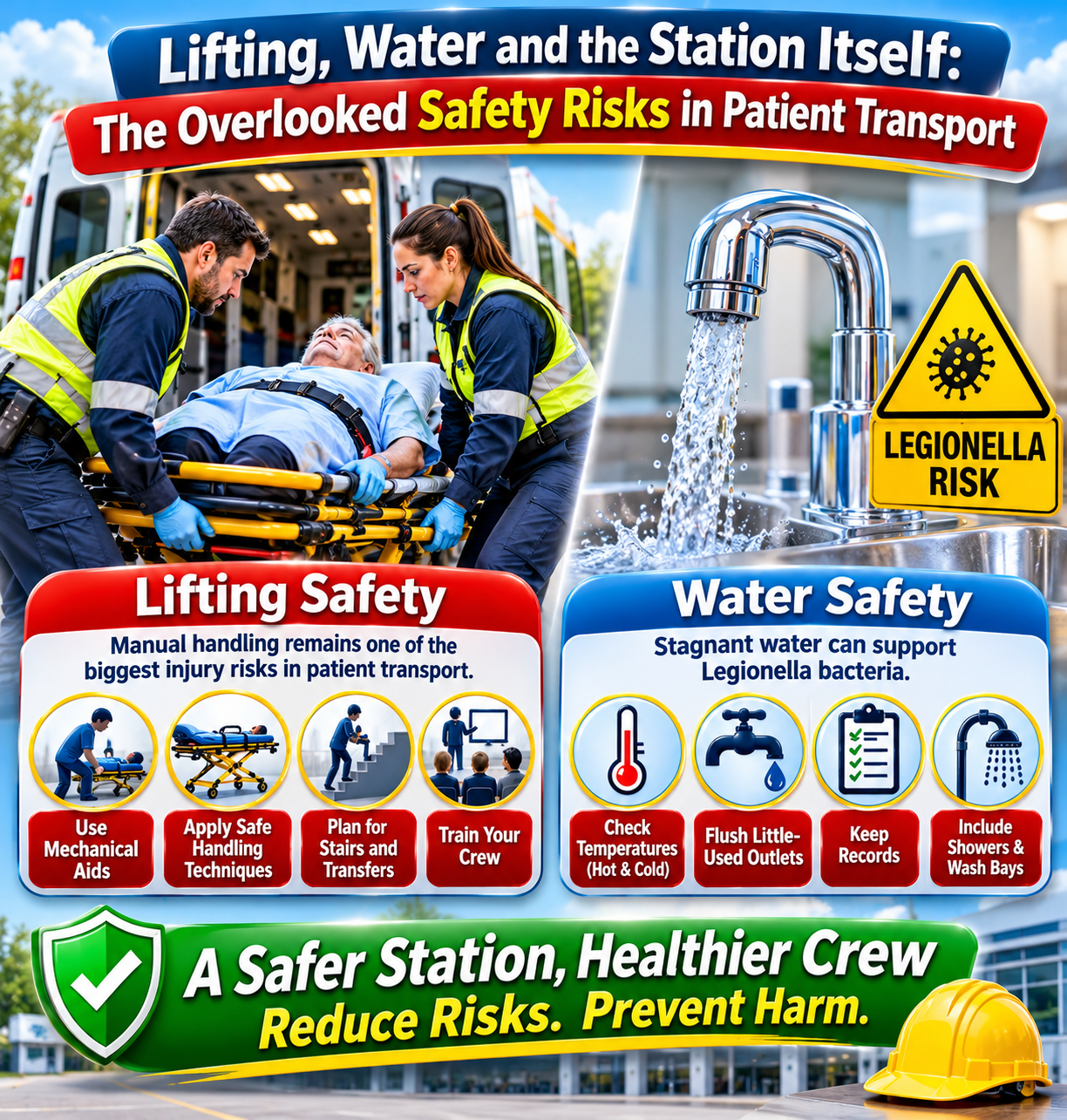
Patient transport concentrates that risk. A crew member may lift, slide or carry the full weight of an adult several times in one call: out of a chair, down a staircase, across a threshold, onto a cot, into the vehicle and out again at the hospital. Each of those moves is a manual handling task in its own right, and each needs to appear in the risk assessment with its own controls.
Where the load actually comes from
When services break their handling incidents down, the same few tasks tend to come up:
Stairs and tight landings. Carrying a patient down a narrow staircase is one of the heaviest and most awkward loads a crew handles.
Raising and lowering the cot. Manual cots ask the crew to lift the patient and the frame together, often at the end of a long shift.
Loading into the vehicle. Lifting a loaded cot into a vehicle puts strain on the back and shoulders, and it is repeated on every call.
Lateral transfers. Moving a patient from bed to cot by hand, without a slide sheet or board, means reaching and twisting under load.
Matching the equipment to the risk assessment
The hierarchy of control applies here as it does anywhere: avoid the manual task where you can, reduce it where you can’t, and train for what is left. In patient transport, “reduce” usually means equipment. When a service reviews its fleet, it is worth setting the lifting aids built into current Ferno patient transport equipment, from powered cots to tracked stair chairs, against each manual task in the risk assessment, so the purchase is driven by the injuries the service actually sees rather than by a catalog.
Two points are easy to miss. First, equipment only reduces risk if crews use it, which means training on every shift pattern, not just at induction. Second, a powered cot or stair chair brings its own maintenance and inspection duties, so it belongs on the equipment register the day it arrives.
The station: a workplace with its own water risks
Crews spend a large part of every shift at base, and the station is a workplace like any other. One hazard that rarely gets attention is the water system.
Ambulance and patient transport stations often have showers for crews after contaminated calls, vehicle wash bays, decontamination sinks and, in some cases, emergency showers. Many have outlets that go unused for days at a time, especially on smaller or relief stations. Stagnant warm water is exactly where Legionella bacteria grow.
What the law asks for
In Great Britain, employers and anyone in control of premises must identify and assess sources of Legionella risk, manage and control those risks, and keep proper records. HSE notes that every system needs a risk assessment, but not every system needs elaborate controls (HSE, Legionella: what you must do). The detail sits in HSE’s Approved Code of Practice, L8: the control of legionella bacteria in water systems. HSE lists water outlets and emergency showers among the parts of a system that can create a risk.
For a station, a sensible approach covers:
- A named responsible person for the water system, with cover when they are off.
- A flushing routine for little-used outlets, showers and hoses, written down and signed off.
- Temperature checks on hot and cold water at agreed points.
- A clear record of where every outlet is, including the wash bay and any emergency shower.
The water bill is part of the same picture
Water safety and water cost are usually handled by different people, but they rely on the same information. Meter readings, usage patterns and a list of every supply point feed both the risk assessment and the budget.
That matters more than it used to. In April 2017, England opened what Ofwat describes as the largest competitive water retail market in the world, and about 1.2 million non-household customers in England can now choose who supplies their retail water services (Ofwat, business retail market). For a service running several stations, a business water supplier comparison can bring every site onto one bill and one set of meter data, and the same usage records will show the safety lead which outlets are hardly used and need flushing.
Unusually low use at one outlet can point to stagnant water. A sudden rise can point to a leak or a fault in the wash bay. Either one is worth a look from both the budget holder and the safety lead.
Bringing the two together
Lifting injuries and water hygiene look like separate subjects, but in a patient transport service they share an owner: whoever is responsible for the health and safety of crews, on the road and at base. Both are hazards that build up slowly, both are covered by clear legal duties, and both get worse when nobody is checking.
A service that reviews its handling equipment against real incident data, and its station water system against L8, will cut injuries and reduce the chance of an outbreak. It will often save money as well, through fewer days lost to back injuries and a water contract set against how the station actually uses water.
Read: Eye Wash Safety Program: Ensuring Optimal Protection and Preparedness