
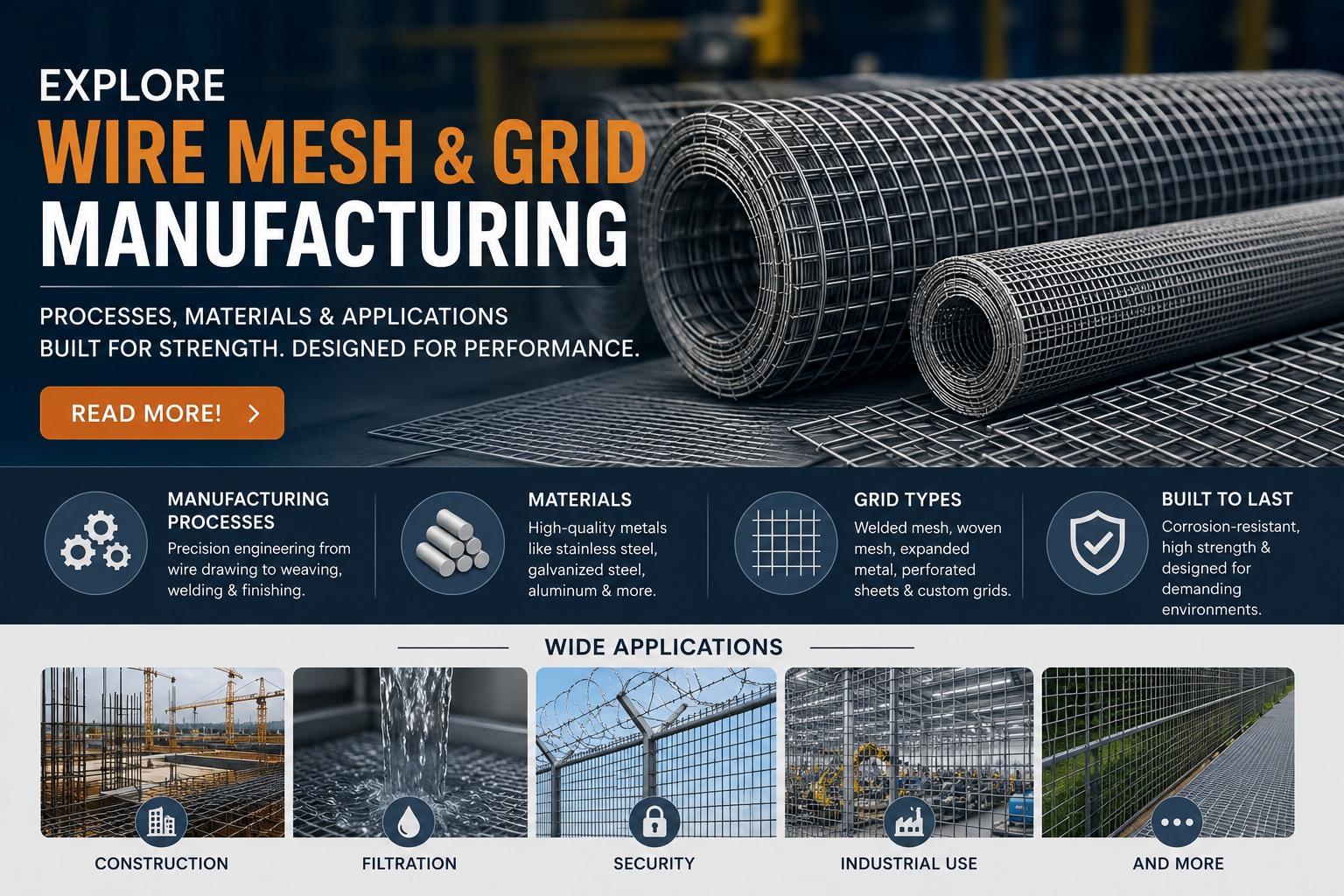
Look around almost any industrial site, construction zone, or commercial farm. You will likely spot wire mesh and grids quietly doing the heavy lifting. These metal structures form the backbone of countless modern operations. From filtering microscopic particles to reinforcing massive concrete walls, wire products are essential to global infrastructure.
A Brief History of Wire Production
Humans have shaped metal wire for thousands of years. Early artisans hammered gold and copper into thin threads to create intricate jewelry and decorative armor. However, industrialization brought the first mechanical wire drawing machines, allowing factories to produce strong, uniform iron and steel wire at scale.
As the demand for infrastructure grew rapidly during the 19th and 20th centuries, manufacturers developed automated weaving and welding techniques. This technological leap transformed simple strands of wire into the heavy-duty grids and fine filtration meshes we rely on heavily today.
The Manufacturing Process
Turning raw metal into a finished grid involves a series of highly precise steps. Manufacturers must carefully manage the material properties to ensure the final product performs under stress.
Wire drawing
The manufacturing process begins with wire drawing. Large machines pull raw metal rods through a series of progressively smaller dies. This cold-working process reduces the diameter of the wire while significantly increasing its tensile strength. Depending on the intended application, manufacturers can create wires as thick as a standard pencil or as fine as a single human hair.
Weaving and welding techniques
Once the wire reaches the correct thickness, it moves to the assembly stage. For woven mesh, massive industrial looms interlace the wires much like weaving threads of cloth. For welded grids, automated machinery lays wires out in a precise cross-hatch pattern and applies localized electrical currents to fuse the intersecting points together permanently.
Quality control and standards
Reliable manufacturers run strict quality control checks throughout the entire production cycle. They test the wire’s tensile strength, verify the accuracy of the microscopic weld points, and ensure the grid spacing meets exact industry tolerances. These standards guarantee the mesh will not fail under load.
Types of Wire Mesh and Grids
Not all wire products are created equal. Different manufacturing techniques produce distinct types of mesh tailored to specific tasks.
Woven mesh
Woven mesh comes in several distinct styles. Plain weave is the most common approach, where wires simply cross over and under each other in an alternating pattern. Twilled weave allows for thicker wires and smaller openings, creating a much denser and stronger mesh. Crimped mesh uses pre-bent wires to lock the intersections tightly in place, preventing the grid from shifting.
Welded mesh
Welded mesh offers incredible rigidity and structural stability. Standard welded mesh works perfectly for light fencing, animal cages, and small enclosures. Heavy-duty welded grids use thick steel bars for major structural projects, ensuring the panel holds its shape perfectly under immense pressure.
Expanded and perforated metal
While not made from individually drawn wires, these grids serve very similar purposes. Expanded metal is created by slitting and stretching a solid metal sheet to form uniform diamond-shaped holes. Perforated metal involves punching specific hole patterns directly into a flat metal sheet. Both options provide excellent durability and high structural integrity.
Applications Across Industries
Because wire mesh is highly adaptable, nearly every major industry utilizes these products to solve complex logistical and structural challenges.
Construction
The construction industry consumes vast amounts of welded grids every single year. Builders embed heavy steel grids into concrete slabs and retaining walls to provide critical structural reinforcement. Architects also utilize lighter, highly decorative woven meshes for modern building facades and interior design elements.
Read: A free detailed guide for Welding and metal fabrication Safety
Automotive
Vehicles require precise filtration and robust physical protection. Wire mesh acts as the primary foundational material for oil filters, cabin air intakes, and custom radiator grilles that protect delicate engine components from road debris.
Agriculture
Commercial farms rely heavily on wire products to maintain daily operations. Applications include secure animal enclosures, durable boundary fencing, and heavy-duty sieves designed for sorting bulk grains and seeds.
Mining
Mining operations require incredibly tough materials that can survive constant abuse. Heavy woven meshes act as vibrating screens to sort crushed rocks and extract valuable minerals. Specialized wire grids also provide essential roof support in deep underground mine shafts.
Advantages of Using Wire Mesh and Grids
Using wire mesh brings several distinct benefits to any commercial project. The open structure provides excellent strength while remaining relatively lightweight, reducing overall shipping and handling costs. The materials are highly durable, especially when coated with zinc or PVC to prevent long-term rust and corrosion.
Furthermore, producing wire grids is highly cost-effective compared to casting solid metal parts. Beyond their direct functional benefits, woven meshes offer an undeniable aesthetic appeal, making them increasingly popular in contemporary architectural design and urban planning.
Innovations in Wire Manufacturing
The metal fabrication industry continues to evolve rapidly. Manufacturers now use advanced alloys that withstand extreme temperatures and highly corrosive environments. This is particularly useful in specialized fields like aerospace wire forming, where critical components must survive rigorous atmospheric conditions.
Production facilities are also adopting sustainable practices by recycling scrap metal and installing energy-efficient drawing machines. Finally, AI-driven automation allows modern factories to monitor weld quality in real-time using complex camera systems, drastically reducing material waste and production errors.
Choosing the Right Manufacturer
Selecting a reliable production partner ensures your project runs smoothly from start to finish. Look for companies with a proven track record in your specific industry. Ask detailed questions about their quality control certifications and their ability to handle custom grid patterns. A good manufacturer should offer clear communication, transparent pricing, and robust testing procedures to guarantee their mesh meets your exact project specifications.
Conclusion
Wire mesh and grids might seem like simple products at first glance, but their manufacturing requires immense precision and mechanical expertise. Understanding how these materials are made helps you make informed purchasing decisions for your organization.