
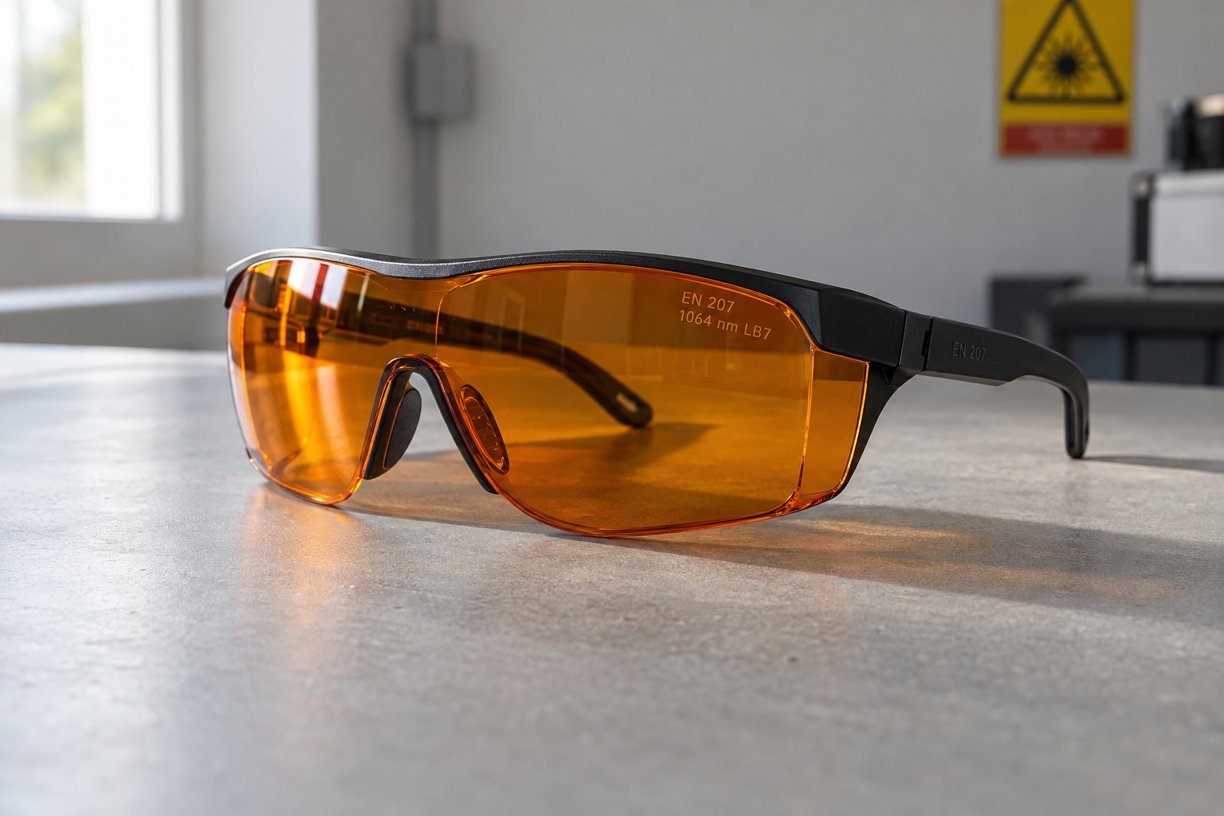
Choosing the right laser safety eyewear is critical for preventing serious eye injuries during industrial laser processes. Regulatory requirements differ depending on the region, making it important to understand both American and European standards. Interpreting markings like “D 1064 LB7” ensures that workers are adequately protected on the job.
Laser hazards in industrial environments can arise from direct exposure to laser beams, reflections, or even diffuse scatter from high-power lasers. As a result, selecting the correct eyewear involves more than picking a product with a generic safety label. Recognizing key certification standards and understanding lens markings are essential skills for safety managers in facilities using lasers. This article explains how ANSI Z136, EN 207, and EN 208 differ, how to decode lens and frame ratings, and what to look for during assessment and audits.
Overview of ANSI Z136 and Z87.1 in the US
In the United States, ANSI Z136.1 serves as the fundamental guideline for laser safety. This standard defines classes of lasers, control options, and minimum requirements for safety measures, including personal protective equipment. While ANSI Z136.1 outlines how to select appropriate laser eyewear based on hazard evaluations, the physical requirements of protective eyewear fall under ANSI Z87.1.
ANSI Z87.1 is primarily a general standard for impact-resistant eyewear and face protection, not specific to lasers. However, glasses that meet both Z87.1 for durability and ANSI Z136.1 recommendations for wavelength and attenuation are necessary for facilities that operate industrial lasers. Unlike European standards, ANSI does not require marking eyewear for specific laser types or wavelengths, so users must rely on filter charts and optical density (OD) values provided by the manufacturer.
EN 207 vs EN 208: Protection and alignment eyewear for Europe and the UK
Laser eyewear standards differ significantly between the US and the EU/UK. EN 207 is the main European and UK standard covering protective eyewear for direct and scattered laser radiation during normal operations. Glasses certified to EN 207 must provide full protection based on the type of laser emission (continuous-wave or pulsed), specific wavelengths, and power levels present in the workplace.
EN 208, on the other hand, is designed for safe alignment tasks. This means some visible light is transmitted so users can see a low-power reference beam during adjustments. For example, technicians aligning a visible laser with an infrared system may use EN 208 eyewear for setup, then switch to EN 207-rated glasses during active production when exposure levels rise. Understanding which standard applies to each workplace scenario is vital for compliance and effective protection.
How to interpret LB scale, optical density, and eyewear markings
One of the key differences buyers notice is in the marking systems: the “LB” (Laser Blocking) scale is used in EN 207 and EN 208, while the “OD” (Optical Density) scale is more common with ANSI-based eyewear. Both scales describe how much laser radiation the filter attenuates, but the LB scale always refers to a specific wavelength, emission type, and protection level in European contexts.
Eyewear that is fully compliant for high-power operation will display CE or UKCA marks as well as the relevant EN 207 code. For example, a marking such as “D 1064 LB7” signifies that the glasses protect against pulsed emissions at 1064 nm with an attenuation factor corresponding to LB7. When evaluating eyewear for use in the US, EU, or UK, buyers should review both the regulatory mark and the full filter code or chart to ensure compatibility with their workplace lasers.
For tasks requiring operational protection at multiple wavelengths or laser modes, such as working in a facility with both infrared and visible alignment lasers, users may need several pairs with different LB or OD ratings. When considering EN 207 laser glasses, note that the markings detail exactly which wavelengths, pulse durations, and power levels are protected. This makes it easier to match eyewear to specific lasers and to document compliance for audits or inspections.
Certifications, markings, and audit readiness: Best practices
Ensuring eyewear conformity is not just about the glasses themselves. As with other safety certifications, auditors and laser safety officers review documentation such as product certificates, filter charts, maintenance histories, and inspection records tied to each laser source in the facility. Every pair of glasses should be marked on both the filter and the frame, and all markings must be legible and correspond to the actual lasers in use.
Regulatory symbols, such as CE for Europe or UKCA for the United Kingdom, indicate that eyewear has been tested for market compliance, but do not alone confirm suitability for all workplace lasers. During audits, safety records must demonstrate that the eyewear in use is matched to documented hazards for each zone or task, including wavelength-specific OD performance where OD-rated filters are used. Keeping detailed files and updating them with any changes in laser equipment or processes supports both compliance and workplace safety, and ensures operators can quickly reference eyewear markings such as “D 1064 LB7” or appropriate OD values when questioned by external or internal auditors.
Read: https://hsseworld.com/photo-of-the-day-work-safe-with-lasers-laser-safety/