
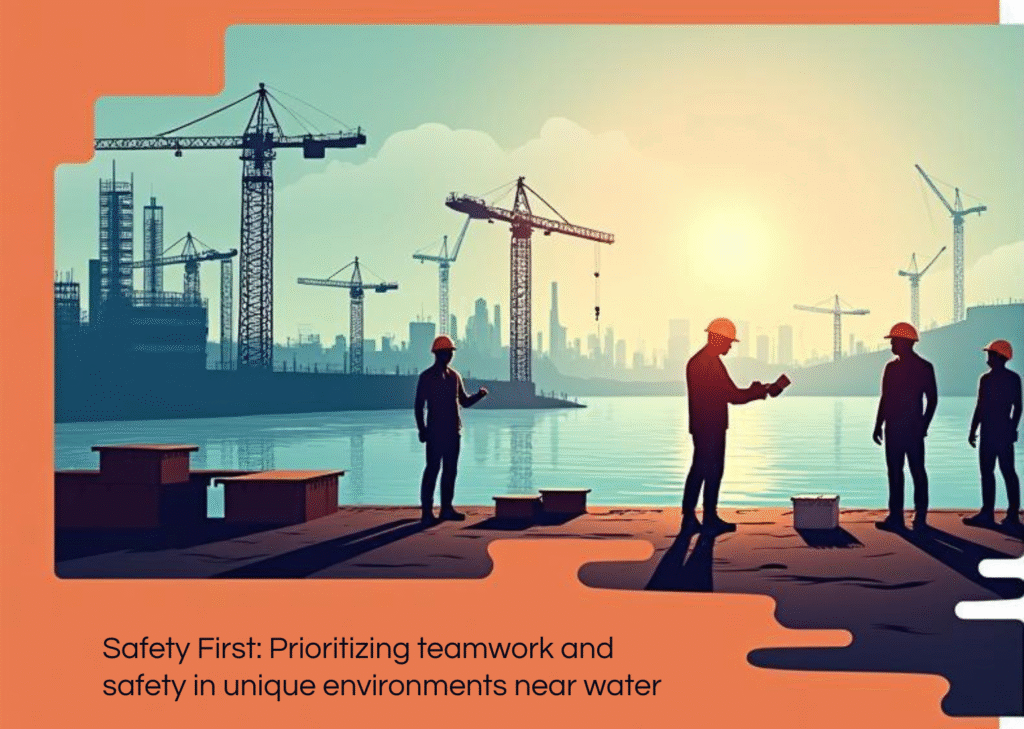
For Health, Safety, and Environment (HSE) professionals, few work environments present a more dynamic and unforgiving set of hazards than those near or over water. Unlike a controlled factory floor, the aquatic environment is constantly shifting—tides ebb and flow, currents can be deceptively strong, weather can change in an instant, and cold water immersion can lead to shock and incapacitation in minutes.
A momentary lapse in judgment, a missing guardrail, or an inadequate rescue plan can turn a routine task into a tragedy. Drowning remains a leading cause of workplace fatalities in sectors like construction, marine operations, and utilities. This isn’t just about compliance; it’s about saving lives. A robust, systematic approach to safety near water is non-negotiable.
This definitive guide will dive deep into the critical components of a safe system of work for operations conducted near water. We will dissect each element, moving beyond the checkbox mentality to understand the why behind the controls, ensuring every worker returns home safely at the end of the day.

1. The Foundation: Pre-Work Risk Assessment and Hazard Identification
Before a single tool is lifted or a step is taken towards the water’s edge, the most crucial phase begins: planning and assessment. A generic risk assessment is insufficient. The assessment for working near water must be task-specific and site-specific.
Key Hazards to Identify:
- Unprotected Edges: Dock edges, riverbanks, unfinished structures, or open hatches on vessels.
- Water Conditions: Currents, tides, waves, water temperature (risk of hypothermia), and visibility.
- Falling Objects: Tools or materials that could fall into the water, striking a worker below or becoming hazardous debris.
- Slippery Surfaces: Algae, moss, ice, snow, or fuel/oil spills on walkways and decks.
- Weather: Wind, lightning, fog, and rapidly changing weather patterns.
- Simultaneous Operations (SIMOPS): Are cranes operating overhead? Are vessels maneuvering nearby? These intersecting activities create complex, compounded risks.
- Biological and Chemical Hazards: Contaminated water, aquatic life (e.g., jellyfish, snakes), or exposure to pollutants.
Controlling the Hazards:
The risk assessment must translate into tangible controls. For the hazard of “falling into water,” the hierarchy of controls should be applied:
- Elimination: Can the work be done away from the edge?
- Substitution: Is there a safer method? (e.g., using a boat with a cherry picker instead of working from the edge).
- Engineering Controls: This is your first line of physical defense. Install temporary edge protection (guardrails, chains, ropes), and use fall protection equipment like safety lines, travel restraint systems, or fall arrest systems. Remember, a fall arrest system is designed to stop a fall already in progress and requires a robust rescue plan for a person suspended in a harness, especially over water.
- Administrative Controls: This includes the Start-Work Checklist, permitting systems, establishing exclusion zones, and implementing clear communication protocols.
- Personal Protective Equipment (PPE): The last line of defense, which we will cover in detail.
2. Establishing the Line of Defense: Exclusion and Restricted Zones
When working near an unguarded edge, creating a physical and visual boundary is paramount. This isn’t just a suggestion; it’s a controlled area.
What are Exclusion/Restricted Zones?
These are clearly demarcated areas where access is limited to authorized personnel only. They serve as a constant visual reminder of the drop-off or hazard.
- How to Demarcate: Use a combination of high-visibility tape, ropes, chains, or painted yellow lines. Supplement this with clear signage stating “DANGER – UNPROTECTED EDGE” or “RESTRICTED AREA – AUTHORIZED PERSONNEL ONLY.”
- Controlling Access: Access to these zones should be strictly managed. This can be through:
- An attendant whose sole responsibility is to monitor entry and exit.
- A permit-to-work system that formally authorizes individuals to enter.
- Temporary physical barriers that are more substantial than tape, such as fencing or gates.
This controlled approach ensures that only those who are equipped, trained, and aware of the specific risks are permitted in the most hazardous areas.
3. The Last Line of Defense: Personal Flotation Devices (PFDs)
A PFD is not just a piece of equipment; it is a potential lifesaver. For any worker authorized to enter an exclusion zone near deep or moving water, a PFD must be mandatory. ( know more about Personal flotation devices (PFDs) )
Selecting the Right PFD:
Not all PFDs are created equal. They must be:
- Approved: Certified to relevant national or international standards (e.g., SOLAS, USCG, ISO).
- Task-Appropriate: A bulky offshore life jacket may hinder a worker performing delicate electrical repairs, whereas an inflatable PFD might be more suitable. Consider the need for harness compatibility.
- Correctly Fitted: A PFD that doesn’t fit is ineffective. It must be the right size for the user.

The Critical Pre-Use Inspection:
A PFD is useless if it fails when needed. Every worker must be trained to perform a quick but thorough inspection before each use:
- Damage: Look for tears, frayed straps, or broken buckles.
- Waterlogging: For foam-filled PFDs, check that the material is buoyant and not saturated.
- Air Leaks: For inflatables, check the CO2 cylinder is secure and hasn’t been accidentally discharged, and that the inflatable bladder is intact.
- Straps and Whistles: Ensure all straps are functional and that any attached safety whistles are present.
A culture that treats PFD inspection with the same rigor as a harness inspection is a culture that takes water safety seriously.
4. Underfoot Safety: Managing Slip, Trip, and Fall Hazards
The walking surface is your primary work platform. Its condition directly impacts the likelihood of a slip or trip, which can easily result in a fall into the water.( Know more about Slips, Trips and Falls Prevention )
Comprehensive Surface Management:
- High-Visibility Markings: Clearly mark the edges of walkways, steps, and changes in level.
- Non-Slip Surfaces: Decks and floors should be treated with non-slip coatings, stick-on abrasive strips, or sand-paint. This is especially critical in areas that are frequently wet.
- Footwear Policy: Mandate the use of non-slip, chemical-resistant safety footwear. This is a simple yet highly effective control.
- Good Housekeeping: Walking surfaces must be kept clear of trip hazards like tools, hoses, and cables. More importantly, they must be free of snow, ice, oil, grease, and chemicals. Implement immediate cleanup procedures for spills.
- Adequate Lighting: Ensure all work areas, pathways, and exclusion zones are well-lit during night operations or in poor weather, eliminating shadows and improving visibility of hazards.
5. Staying Connected: The Critical Role of the Communication Plan
When working near water, the roar of waves, engine noise, and distance can render normal conversation impossible. A failed communication link can delay a warning, a stop-work command, or the initiation of a rescue.
Elements of a Robust Communication Plan:
- Primary and Secondary Methods: Never rely on a single method. The primary method could be waterproof and intrinsically safe two-way radios. The secondary method must be a reliable alternative, such as pre-agreed hand signals or visual signals (flags, lights).
- Testing: Communications equipment must be tested before work commences to ensure functionality and battery life.
- Clear Roles: The Person-in-Charge (PIC) must be clearly identified. Everyone must know who they report to and who has the authority to stop work. If a signaler is required for crane operations, that person must be designated, competent, and in clear view of the operator.
A well-drilled communication plan ensures that the entire team operates as a cohesive unit, aware of their roles and the status of the operation.
Photo of the day: Confined Space rescue
6. Preparing for the Worst: The Non-Negotiable Rescue Plan
Hope is not a strategy. The most dangerous assumption a team can make is that “it won’t happen to us.” If a person enters the water, the response must be immediate, rehearsed, and effective. A delayed rescue is often a recovery mission.
What Makes an Effective Rescue Plan?
- It Must Be Discussed: Every worker must be briefed on the rescue plan during the pre-work meeting. They need to know what to do and what not to do.
- Activation: The plan must clearly state how to raise the alarm. Is it a shout over the radio? A specific alarm signal?
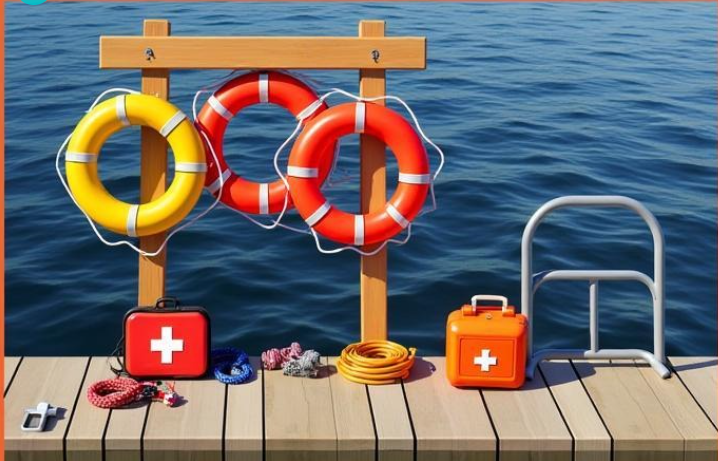
- Equipment Location and Use: The location of rescue equipment must be known to all and be easily accessible. This includes:
- Life Rings with lines attached.
- Throw Bags.
- Pole Hooks or reach tools to pull a person to safety.
- Fast Rescue Craft (FRC) ready for immediate launch.
- The Rescue Crew: Who are the designated rescuers? They must:
- Be available on-site for the duration of the work.
- Be trained and competent in water rescue techniques (never attempt a swimming rescue unless specifically trained to do so).
- Be aware of the specific hazards (e.g., strong currents, cold water shock) that will impact the rescue.
- Environmental Considerations: The plan must be tailored to the environment. A rescue from a stationary dock is different from a rescue from a moving vessel, which is different again from a rescue in a fast-flowing river.
- Escape Routes: Ensure that all designated escape routes, in case of a different emergency like fire, are kept clear and unobstructed.
A rescue plan that sits in a folder is worthless. It must be a living document, practiced through drills, and ingrained in the team’s mindset.
Read: Who should be responsible for rescuing fallen workers?
Conclusion: Building a Culture of Proactive Water Safety
Working near water will always carry inherent risks, but these risks can be managed to an acceptable level. The key lies in moving from a reactive, compliance-driven approach to a proactive, safety-obsessed culture.
This transformation is built on:
- Meticulous Planning: Leaving nothing to chance through thorough, site-specific risk assessments.
- Robust Physical and Administrative Controls: Using barriers, zones, and systems to create layers of defense.
- Uncompromising Reliance on PPE: Ensuring that the last line of defense, like PFDs, is always present and functional.
- Clear and Redundant Communication: Ensuring no worker is ever isolated or unable to call for help.
- A Rehearsed and Ready Rescue Capability: Preparing for the worst to ensure the best possible outcome.
Safety is not a checklist; it’s a commitment. It’s the commitment of every worker to look out for one another, to speak up when something seems unsafe, and to take the time to verify every control. By integrating these principles and using the tools provided, we can ensure that every job near water ends as safely as it began.
Ready to Implement World-Class Water Safety?
Don’t leave your team’s safety to chance. We have transformed the key principles discussed in this article into a practical, ready-to-use tool.
Download our FREE “Work Near Water – Start-Work Checklist” now.


This comprehensive PDF checklist will guide your team through each critical step, from hazard identification to rescue plan verification, ensuring no detail is overlooked before work begins.
[Click Below to Download Your FREE Checklist Now!]
You can have more safety resources in our SAFETY BAG